What is the minimum insurance I can get away with?
 REALLY HONEST
"What's the least insurance we can get away with?" It's a question we hear a lot.
Cash is tight in a growing business. Every pound spent on premiums is a pound not spent on hiring, product or runway. You shouldn't buy cover you don't need - and we regularly tell our clients if they're over-insured, even though it costs us commission in the short term - but “the minimum you can get away with” is the wrong question.
A better one, for every risk you face, is: if this went wrong, could we pay for it ourselves?
Insurance is for the things you couldn't afford to pay for yourself. The rest, you can choose to cover or not.
Alex Littlejohn, Insurance Operations Director at REALLY HONEST, puts it like this;
Start with what the law requires. Then, for the cover you need, I’d usually recommend the highest limits your budget reasonably allows. When a client asks what the minimum is, I turn the question round. How much risk are you comfortable with, and what could the business afford to pay if something went wrong? I see what businesses go through when something goes wrong, both with insurance and without it, and I know which I’d recommend.”
Cover what you can't avoid
Some cover isn't a choice. If you employ anyone, the law almost certainly requires Employers' Liability Insurance. It's the most common cover across our clients for that reason.
The next layer is what other people require of you. Client contracts often name the cover you must hold and the limit. Stockists ask food and retail brands for Product Liability. Investors ask for Directors & Officers before or after a round.
Read those requirements before you sign, not after, because a contract that asks for £5m of Professional Indemnity when you hold £1m is a problem you want to find early.
Ask what would really hurt (or collapse) your business
Beyond the must-haves, think about what could go wrong and what it would cost to fix it.
A useful exercise: write down the three events that would hurt your business the most. For each, ask two questions:
- How likely is it?
- If it happened, could we pay from cash without ending the business?
If the honest answer to the second is no, that's a risk to insure.
- If you sell advice or software, the big risk is a client saying your work cost them money. That's why three in four of our software clients hold Professional Indemnity.
- If you sell a physical product, it's the product hurting someone. Nine in ten of our food and drink clients hold Product Liability.
- If you hold customer data or take payments, it's a breach. Cyber cover is most common among our software and e-commerce clients.
An illustrative example: A 12-person software company builds a stock integration for a retail client. An update contains a bug. For four days, the client's online shop shows items in stock that aren't. The client oversells, cancels hundreds of orders and refunds customers. It then claims £150,000 from the software company for lost profit and the cost of putting things right.
The software company has £80,000 in the bank. Even if the claim is overstated, defending it means lawyers, and legal costs can run into tens of thousands before anything is settled.
Without Professional Indemnity, this one claim could end the business. With it, the insurer handles the defence and pays any settlement up to the policy limit. The company pays its excess.
How to pay less without dropping cover
Managing cost doesn't have to mean dropping cover. There are better levers:
- Raise the excess. This is the amount you pay towards each claim. A higher excess lowers the premium. Pick a figure you could pay tomorrow without strain. This might be a happy medium.
- Set limits to your real exposure. Match them to your contracts and your worst realistic claim, not the biggest number on offer.
- Check what's excluded. The cheapest quote is usually cheap for a reason. Make sure the exclusions don't remove the risk you're buying the policy for in the first place!
- Use the right broker. Choosing a broker with whole-market coverage and who knows your business well is likely to get you the right cover at the right price (read more about Choosing an Insurance Broker).
Keeping a small risk is a sensible decision. Keeping one that could close the business usually isn't.
Be honest about what you don't need
You don't need every cover on offer. Some only matter once a business reaches a certain size, and plenty never get there.
Directors & Officers is the clearest example. It protects directors personally when decisions are challenged, and that risk grows with investors, a board and bigger contracts. Under half of our clients turning over less than £250k hold it. At £5m+, three in four do.
If a cover doesn't protect you from something that would sink you today, and nobody requires it, you might not need it. Look again if the business changes…
Look again when things change
The right cover today may be wrong in six months. Review it when something big shifts:
- you raise money or take on a board (insurance for after a funding round)
- you sign a major client contract
- you start selling into a new country, especially the US
- you hire significantly, or open a new site
- you launch a new product or service
An annual renewal is a natural checkpoint too, but don't wait for it if one of these happens first. It's why we check in with every client each quarter, rather than once a year: changes get picked up before they turn into gaps in cover.
What businesses like yours hold
It can help to see what similar businesses chose. Treat this as a reference point, not a shopping list: your contracts and your risks decide what you need.
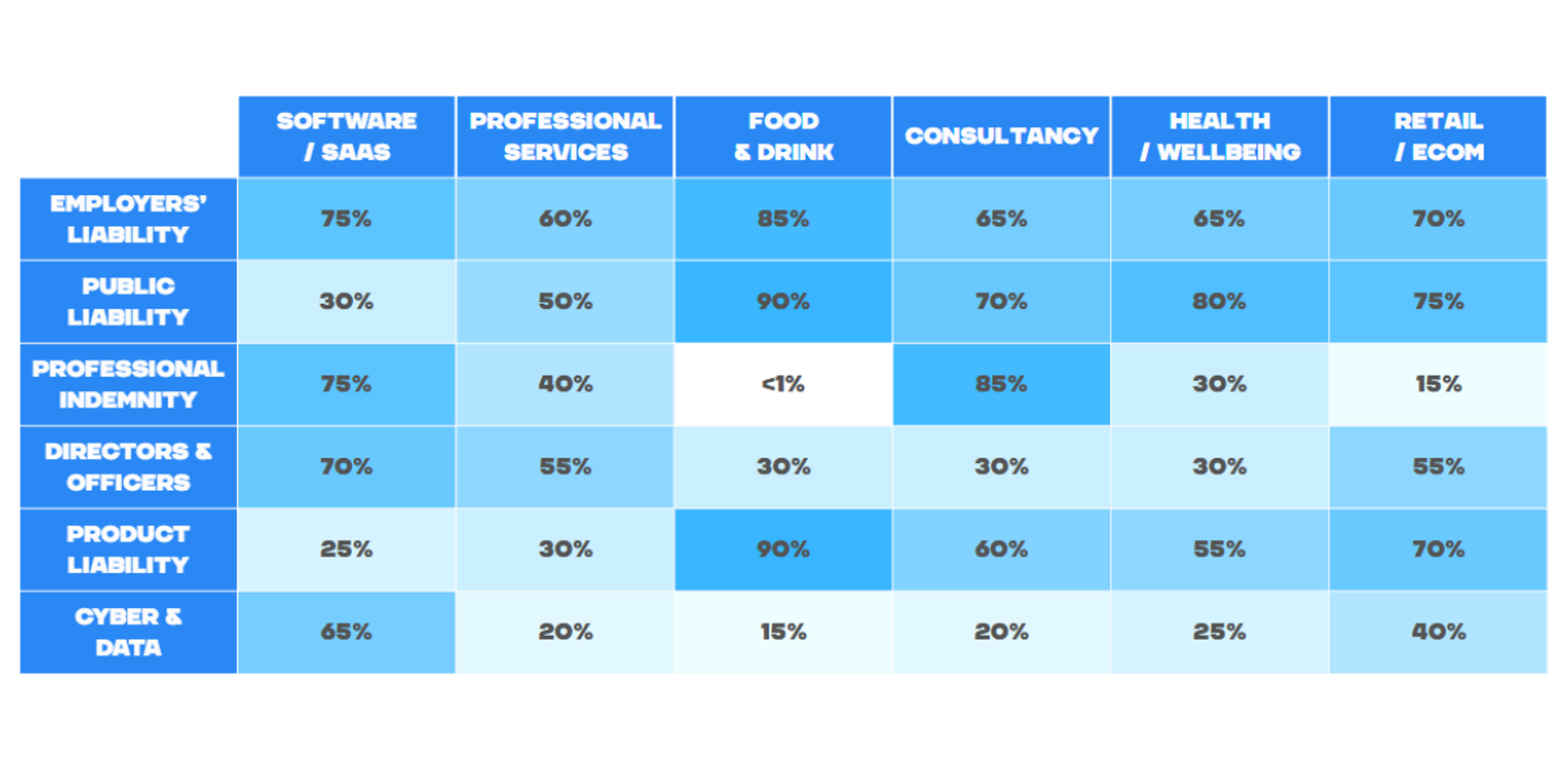
Share of our clients in each sector holding each cover;
Talk it through
If you’d like to talk over your insurance needs, we'll happily tell you what you need, what you don't, and where a higher excess could save you money.
Get a quote today.

About the data
About the data
Figures come from live policies across a sample of 600 REALLY HONEST clients, as of September 2026. They show cover placed through us, so a client may hold other cover elsewhere. This may not reflect the whole UK market. Size is measured by turnover.
Software and SaaS: Employers' Liability 75%, Public Liability 30%, Professional Indemnity 75%, Directors & Officers 70%, Product Liability 25%, Cyber & Data 65%.
Professional services: Employers' Liability 60%, Public Liability 50%, Professional Indemnity 40%, Directors & Officers 55%, Product Liability 30%, Cyber & Data 20%.
Food and drink: Employers' Liability 85%, Public Liability 90%, Professional Indemnity almost none, Directors & Officers 30%, Product Liability 90%, Cyber & Data 15%.
Business consultancy: Employers' Liability 65%, Public Liability 70%, Professional Indemnity 85%, Directors & Officers 30%, Product Liability 60%, Cyber & Data 20%.
Health and wellbeing: Employers' Liability 65%, Public Liability 80%, Professional Indemnity 30%, Directors & Officers 30%, Product Liability 55%, Cyber & Data 25%.
Retail and e-commerce: Employers' Liability 70%, Public Liability 75%, Professional Indemnity 15%, Directors & Officers 55%, Product Liability 70%, Cyber & Data 40%.



Get honest insurance
Join thousands of businesses who trust Really Honest.